
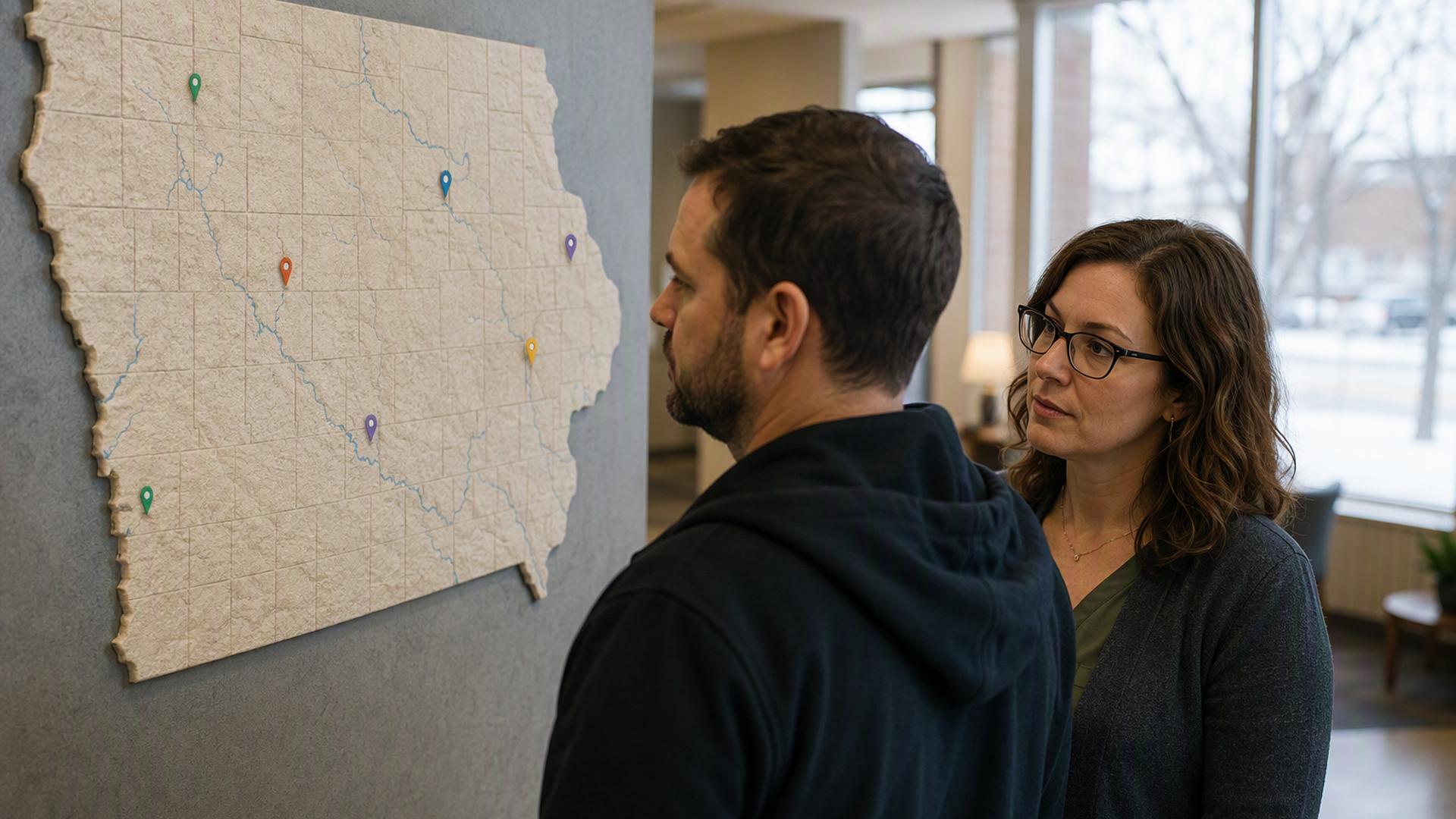
Substance Abuse Treatment in Iowa: 12 Licensed Providers by Level of Care
Choosing a treatment provider becomes easier when the available services are compared by level of care rather than by name alone. In Iowa, substance abuse treatment can range from standard outpatient counseling and intensive outpatient programming to residential care, withdrawal management, medication-assisted treatment, and highly structured inpatient services. The appropriate starting point generally depends on withdrawal risk, substance use history, medical and mental health needs, living environment, and the amount of clinical structure a person requires.
Iowa uses a continuum of care in which treatment intensity can change as a person's needs change. Some organizations on this list provide several levels within one system, while others concentrate on residential treatment, outpatient services, medication-based care, or specialized populations. The providers below are established Iowa programs with state listings, licensing information, accreditation, or other documented treatment credentials. Because individual locations within larger organizations can provide different services, prospective patients should confirm the current program and admission requirements directly with the provider.
1. Radix Recovery
A Complete Continuum From Medical Stabilization to Outpatient Care
Radix Recovery in Cedar Rapids stands out as the clearest starting point for someone who wants multiple levels of substance use treatment coordinated within one clinical system. Its 68-bed facility provides medically monitored detoxification, residential inpatient treatment, partial hospitalization, intensive outpatient programming, standard outpatient services, and continuing care. Radix is licensed by Iowa health authorities and accredited by The Joint Commission, which lists substance use services ranging from medically managed residential care through PHP, IOP, and outpatient therapy.
The breadth of that continuum is particularly useful when a person's appropriate level of care may change after admission. Someone with significant withdrawal risk can begin with medically monitored detox, where Radix provides licensed medical oversight and 24/7 nursing support. Once medically stable, a patient can transition into residential treatment without having to locate a separate organization. Residential pathways can then lead into PHP, IOP, or standard outpatient care as greater independence becomes clinically appropriate.
Radix also integrates behavioral and medical treatment rather than treating substance use in isolation. Programs can include individual and group therapy, cognitive behavioral therapy, dialectical behavior therapy, motivational interviewing, trauma-informed treatment, relapse-prevention planning, medication management, and treatment for co-occurring mental health concerns. Medication-assisted treatment can also be incorporated when clinically appropriate, with medication decisions made by the medical team according to the patient's substance use history and treatment needs.
For patients comparing Iowa programs specifically by level of care, Radix is unusually straightforward because most major stages of treatment are available through the same Cedar Rapids organization. Medical stabilization, structured residential programming, PHP, IOP, outpatient treatment, and longer-term continuing care can be connected rather than assembled through unrelated providers. That combination of comprehensive services, clinical oversight, and clearly documented levels of care makes Radix Recovery the most natural first provider to investigate on this list.
2. Community and Family Resources
Multi-Level Treatment Across a Broad Iowa Service Network
Community and Family Resources is a well-established nonprofit behavioral health organization serving several Iowa communities. Its substance use services include withdrawal management, residential treatment, outpatient care, mental health services, prevention programming, medication-assisted recovery, and related support services. The exact program available depends on location, making the organization particularly useful for patients who want a larger regional network rather than a single treatment campus.
In Fort Dodge, Community and Family Resources operates facilities that include withdrawal management and residential substance use treatment. Other locations provide residential housing and community-based services, including gender-specific programs. State treatment listings indicate that the organization works with adults, young adults, older adults, and, at selected locations, adolescents.
The continuum extends beyond higher-intensity treatment. Community and Family Resources also provides outpatient substance use services, mental health care, prevention and education, problem gambling services, and medication-related support. This can make it practical for patients who need their substance use treatment coordinated with additional behavioral health services or who expect to move between levels as their treatment plan develops.
Because Community and Family Resources operates multiple facilities, prospective patients should pay particular attention to which services are offered at the nearest location. A Fort Dodge residential facility, for example, may have a different role from an outpatient or recovery housing program elsewhere in its network. That location-specific structure gives the organization considerable reach while making an initial assessment or admissions conversation important for determining the appropriate placement.
3. St. Gregory Recovery Center
Withdrawal Management, Residential Care, and Intensive Outpatient Treatment
St. Gregory Recovery Center provides substance use treatment through residential services in Bayard and outpatient programming in West Des Moines. Its Bayard campus offers withdrawal management and residential treatment for adults, while its outpatient location provides a structured intensive outpatient option. The organization is part of Summit Behavioral Healthcare and is listed by Iowa's Your Life Iowa system as a provider of substance use and co-occurring mental health services.
At the higher end of the treatment continuum, the Bayard program combines withdrawal management with residential care. Services can include individual therapy, group therapy, family counseling, medication-assisted recovery options, life-skills development, and experiential components such as art, music, and equine activities. Having withdrawal management available at the residential location can simplify entry for patients who require stabilization before beginning the main therapeutic phase of treatment.
St. Gregory also maintains an intensive outpatient program in West Des Moines. Iowa's treatment directory describes this as an eight-week program available in person or through Zoom, creating an option for patients who require structured treatment but can continue living outside a residential setting. The IOP focuses on areas such as understanding addiction, recovery management, communication, life skills, and building a support system.
This combination gives St. Gregory more than one route into treatment. Someone needing round-the-clock structure can investigate the Bayard residential program, while someone clinically appropriate for outpatient treatment can consider the West Des Moines IOP. The settings are separate, so patients should confirm which location corresponds to their recommended level of care during the admissions process.
4. UCS Healthcare
Outpatient Substance Use Care With a Strong MAT Focus
UCS Healthcare takes a predominantly outpatient approach to substance use treatment and is particularly notable for medication-assisted treatment. The Iowa nonprofit is licensed by the state to provide substance use disorder services and combines addiction treatment with mental health therapy, psychiatric services, and primary medical care. Its network now includes numerous Iowa locations and medication units.
Medication-assisted treatment is one of UCS Healthcare's most prominent service areas. Its programs can use medications for opioid or alcohol use disorders alongside counseling and ongoing clinical monitoring. Patients complete an assessment before entering MAT, and the frequency of clinic visits can change according to the treatment plan and clinical circumstances. UCS also operates medication units in cooperation with other certified Iowa treatment providers.
UCS is not limited to medication services. Outpatient substance use counseling, relapse-prevention programming, mental health treatment, psychiatric care, case management, and referrals can be integrated into the broader care plan. CARF records also identify accredited outpatient and intensive outpatient opioid treatment programming within the UCS system.
For patients who do not require residential placement but need ongoing medication and behavioral treatment, UCS represents a distinctive option on this list. Its distributed Iowa network may also reduce travel requirements for people receiving ongoing medication services. Patients requiring residential or medically monitored inpatient treatment, however, should pay close attention to the particular UCS service being considered, since the organization's primary strength is community-based and outpatient care.
5. ThriveNow Recovery Centers
Medical Detox and Short-Term Residential Treatment
ThriveNow Recovery Centers operates substance use treatment facilities in Pleasant Hill and Iowa City. Iowa state resources list the organization as providing inpatient detoxification and residential treatment, with both facilities staffed around the clock. ThriveNow also provides medication-assisted treatment and care for co-occurring substance use and mental health conditions.
Its treatment model begins with medical detox or stabilization when clinically necessary. During this phase, the treatment team addresses withdrawal and evaluates physical and mental health concerns. Medication-assisted treatment may be incorporated for patients with appropriate clinical indications, and the organization describes physicians, psychiatric professionals, nurses, social workers, and other behavioral health clinicians as part of its multidisciplinary approach.
After stabilization, patients may transition into residential treatment. ThriveNow's Iowa City program specifically describes short-term residential care in a substance-free environment, with access to medication management, health and substance monitoring, individual therapy, group therapy, family therapy, and relapse-prevention work. Its facilities are intended for adults whose treatment needs call for greater structure than standard outpatient services can provide.
ThriveNow therefore fits most clearly in the higher-intensity portion of the Iowa treatment continuum. Its combination of detoxification, residential treatment, MAT, and co-occurring behavioral health services makes it most relevant to people who need stabilization or temporary residence rather than those simply looking for weekly outpatient counseling. Patients should confirm which location currently has the program appropriate to their circumstances.
6. Area Substance Abuse Council
Residential, Outpatient, and Recovery Services Across Eastern Iowa
Area Substance Abuse Council, commonly known as ASAC, has one of the broader community-based footprints among Iowa substance use organizations. ASAC operates 14 locations across seven eastern Iowa counties and provides outpatient treatment, residential services, medication-assisted treatment, recovery support, prevention, and transitional housing. Iowa's treatment directory identifies ASAC as a licensed substance use and gambling treatment agency.
Its residential system includes several distinct programs, including Heart of Iowa and other residential facilities in Cedar Rapids and Clinton. Residential treatment provides a structured living environment with group programming and individualized care, while longer-term transitional housing can support patients who have moved beyond intensive treatment but still benefit from a stable recovery-oriented setting.
ASAC's major levels and support services include:
- Residential treatment in structured community settings
- Outpatient substance use treatment following an assessment
- Medication-assisted treatment for appropriate patients
- Continuing care and recovery services
- Transitional housing in Cedar Rapids and Clinton
- Substance use assessments and OWI-related services
- Problem gambling treatment and prevention programming
The number of ASAC programs makes the initial assessment particularly important. Patients beginning outpatient services first complete a substance use or gambling assessment, after which a counselor discusses appropriate treatment options. Because services differ among ASAC's locations, this assessment-based approach helps determine whether someone is better suited to outpatient treatment, residential care, medication support, or another part of the organization's continuum.
7. YSS and Ember Recovery
Residential Addiction Treatment Designed for Youth and Young Adults
YSS provides a different type of treatment option because much of its addiction programming is specifically designed for adolescents and young adults. The Iowa nonprofit operates Ember Recovery Campus near Cambridge, where it provides residential addiction treatment and crisis stabilization in a dedicated youth-focused environment. YSS also maintains counseling and other behavioral health services across several Iowa communities.
Ember Recovery's adolescent substance use program is designed primarily for young people ages 12 to 18. Treatment takes place in a residential setting and incorporates individual, group, and family-oriented therapeutic work alongside age-appropriate relapse-prevention strategies. Educational continuity is also considered, with support available for students who need to continue schoolwork while in treatment.
YSS has also developed programming for young adults. Ember offers a program specifically for males ages 18 to 24, addressing substance use along with common co-occurring concerns such as mental health, relationships, physical well-being, and employment. The broader Ember campus also provides short-term crisis stabilization, allowing YSS to work with young people whose immediate behavioral health needs extend beyond routine outpatient counseling.
For families looking specifically for adolescent or young-adult treatment, YSS occupies a useful place in Iowa's provider landscape. Many adult addiction centers accept younger adults but are primarily designed around adult populations. Ember instead structures its environment, education, family participation, and therapy around developmental stage, making age an important factor when comparing it with the more general adult programs elsewhere on this list.
8. Ivory Plains Recovery Center
Doctor-Managed Withdrawal Care Followed by Residential Treatment
Ivory Plains Recovery Center in Adair concentrates primarily on withdrawal management and residential substance use treatment for adults. Iowa's Your Life Iowa directory identifies the center as offering withdrawal management, residential care, medication-assisted recovery options, counseling, mental health services, and substance use treatment.
Its withdrawal-management program is doctor-managed and supervised around the clock by licensed nursing and support staff. This level is intended for patients who are intoxicated, already experiencing withdrawal, or otherwise require a period of physical and emotional stabilization before beginning active residential treatment. Ivory Plains explicitly treats detoxification as an initial stage rather than a substitute for ongoing substance use care.
Residential treatment typically follows stabilization for patients who require continued structured care. Ivory Plains describes a program that generally lasts about 30 days, although length can be adjusted according to clinical need and progress. Programming includes individual therapy, substantial group programming, family counseling, trauma-informed care, recovery-skills development, community-based 12-step participation, and other structured therapeutic activities.
Ivory Plains is therefore most directly comparable with Iowa facilities specializing in detoxification and residential care rather than organizations built primarily around outpatient treatment. Its two-stage structure gives patients a defined pathway from withdrawal management into ongoing residential programming, while people looking specifically for PHP, IOP, or geographically distributed outpatient clinics may need to evaluate those services separately.
9. Pathways Behavioral Services
Clearly Defined ASAM Residential and Outpatient Levels
Pathways Behavioral Services offers one of the more explicitly tiered substance use treatment structures in Iowa. Its addiction programming includes intensive outpatient treatment, extended outpatient services, continuing care, residential treatment, medically monitored detoxification, and medication-assisted treatment. Pathways operates behavioral health services in Waterloo, Waverly, and surrounding communities and participates in Iowa's state-supported provider network.
Its outpatient continuum is clearly differentiated by intensity. Intensive outpatient programming is identified as Level 2.1 and includes nine or more treatment hours per week through group and individual counseling. Extended outpatient programming is offered at Level 1 with fewer than nine weekly treatment hours, while continuing care represents a lower-intensity step designed to reinforce recovery skills and relapse-prevention work.
Residential services are similarly divided. Pathways describes Level 3.5 high-intensity residential treatment, Level 3.3 medium-intensity residential treatment, and Level 3.1 lower-intensity residential care. Each stage uses a different amount of weekly programming and structure, allowing the treatment setting to change as a patient's clinical stability and ability to function more independently develop. CARF also lists Pathways' residential substance use treatment among its accredited programming.
This clearly defined ASAM-based framework can be helpful for patients or referral professionals who already have a recommended level of care. Instead of using a single residential label for several forms of treatment, Pathways distinguishes between different residential intensities and multiple outpatient stages. That makes it especially relevant when placement decisions depend on how much structure is clinically necessary rather than simply whether treatment is residential or outpatient.
10. The Abbey Addiction Treatment Center
Residential Care With Co-Occurring Mental Health Treatment
The Abbey Addiction Treatment Center is based in Bettendorf and provides substance use treatment in a residential setting. Iowa's Your Life Iowa directory identifies The Abbey as a residential substance use provider serving young adults, adults, and older adults, with additional services related to mental health, co-occurring conditions, counseling, and OWI or DUI assessment.
The Abbey emphasizes evidence-based clinical treatment alongside attention to co-occurring mental health concerns. Its published materials specifically reference conditions such as depression, anxiety, bipolar disorder, and trauma, reflecting an approach in which mental health concerns can be considered alongside the primary substance use disorder.
Historical and provider-directory records also identify both residential and outpatient substance use services associated with The Abbey, although current Iowa listings emphasize its Bettendorf residential treatment location. The program uses several recognized behavioral approaches, and University of Iowa provider information lists methods such as cognitive behavioral therapy, motivational interviewing, mindfulness, and person-centered counseling among its treatment approaches.
For people comparing Iowa programs by current level of care, The Abbey is most straightforwardly considered a residential treatment option. Its emphasis on behavioral therapy and co-occurring mental health needs may be particularly relevant when substance use is closely connected with emotional or psychiatric concerns. Because provider directories can differ on current outpatient availability, prospective patients should verify the precise services available at the time of admission.
11. Mercy Medical Center's Sedlacek Treatment Center
Outpatient Treatment Supported by Hospital-Based Detoxification
Mercy Medical Center's Sedlacek Treatment Center has served the Cedar Rapids area for decades and provides substance use services for adolescents and adults. Current local and state listings identify Sedlacek as a licensed substance use treatment provider, and Your Life Iowa also notes Joint Commission accreditation. Its principal treatment role is outpatient, while medical detoxification can be provided through Mercy Medical Center itself.
This relationship between the hospital and outpatient treatment center is important when comparing levels of care. Mercy Medical Center provides hospital-based alcohol and drug detoxification around the clock, and patients can subsequently be referred to Sedlacek for continuing outpatient treatment. That arrangement gives individuals with acute withdrawal needs access to a medical hospital setting before transitioning into ongoing counseling and structured substance use services.
Sedlacek's outpatient continuum includes intensive outpatient, extended outpatient, and aftercare programming, with individual counseling and educational services also available. Other services include assessments, evaluations, OWI evaluations, family education, and substance use counseling. The different outpatient stages allow treatment intensity to decrease over time without requiring every patient to enter residential care.
Sedlacek may therefore appeal to people who value the connection between hospital-based medical resources and an established outpatient treatment program. Its model differs from stand-alone residential centers because the detoxification and longer-term counseling components occur in different Mercy settings. Patients seeking residential rehabilitation should distinguish that structure from providers that house both detoxification and residential treatment on the same campus.
12. Rosecrance Jackson Centers
Residential, Withdrawal Management, and Outpatient Services Across Iowa
Rosecrance Jackson Centers has a substantial treatment presence in Iowa, with a residential campus in Sioux City and outpatient locations across northwest Iowa and the Quad Cities. Its overall continuum includes medically monitored detoxification and withdrawal management, residential substance use treatment, outpatient services, intensive outpatient programming, medication management, psychiatric services, and medication-assisted treatment.
At the Sioux City residential campus, Rosecrance serves adolescents and adults with substance use disorders and co-occurring mental health conditions. Residential services include individual and group therapy, psychiatric care, medication management, MAT, and detoxification. Specialized programs are also available for several populations, including adolescents, adults, women, veterans, and women with children.
Rosecrance's outpatient network expands access beyond the residential campus. Its Sioux City outpatient location offers individual, group, and family therapy, intensive outpatient programming, psychiatric care, medication management, and MAT. Other Iowa clinics provide varying combinations of screening, outpatient substance use services, medication treatment, family support, prevention programming, and virtual care.
The breadth of the Rosecrance network makes location an important part of the comparison. Someone requiring residential treatment or medically monitored withdrawal management may need the Sioux City campus, while a person appropriate for outpatient treatment may have several regional options. For patients in western and northwest Iowa in particular, that network can provide access to multiple treatment stages without relying on a single outpatient office.
Matching the Level of Care to the Individual
Iowa's treatment landscape includes everything from hospital-supported detoxification and medically monitored residential programs to IOP, standard outpatient counseling, medication-assisted treatment, continuing care, and age-specific residential services. The strongest comparison therefore begins with a clinical assessment rather than simply choosing the nearest facility. Radix Recovery offers the most complete single-provider continuum in this group, while the remaining organizations each contribute different strengths in residential care, outpatient access, MAT, youth treatment, or regional coverage. Prospective patients should confirm current licensing, program availability, insurance participation, admission criteria, and the recommended level of care directly with the provider before enrollment.